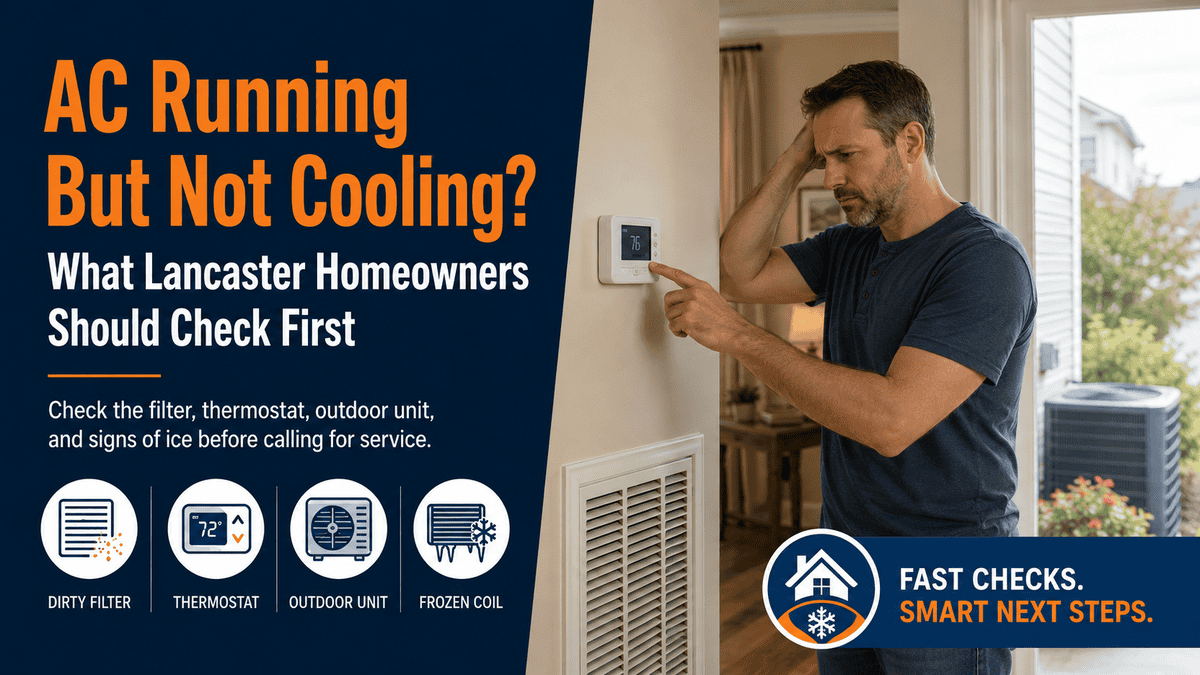
AC Running But Not Cooling? What Lancaster Homeowners Should Check First
If your AC is running but not cooling your home, the most likely causes are a dirty air filter, a refrigerant leak, a frozen evaporator coil, or a failing compressor. The good news: some of these you can fix in minutes. Others need a licensed HVAC technician before they get worse. This guide walks Lancaster County homeowners through exactly what to check, in the right order, so you’re not guessing in the heat.
1. Check Your Air Filter First (This Fixes More Problems Than You’d Think)
A clogged air filter is the single most common reason an AC runs without cooling. When the filter is packed with dust and debris, airflow drops so dramatically that the system can’t transfer heat out of your home efficiently.
Pull out your filter and hold it up to a light. If you can’t see light through it, it needs to go. Standard 1-inch filters should be replaced every 30 to 60 days during heavy cooling season. Thicker 4-inch media filters can last 6 to 12 months, but Lancaster’s humidity and pollen levels push them toward the shorter end of that range.
Replacing a $10 to $20 filter takes three minutes and restores airflow immediately. If your system starts blowing cooler air within 30 minutes of a filter swap, you found your problem.
2. Look at Your Thermostat Settings Before Assuming the Worst
It sounds obvious, but thermostat errors cause a surprising number of “my AC isn’t working” service calls. Check these three things before anything else:
- Mode: Make sure it’s set to “Cool,” not “Fan Only.” Fan-only mode circulates air without activating the compressor, so the air feels like it’s moving but never gets cold.
- Set point: Your thermostat should be set at least 3 to 5 degrees below the current indoor temperature to trigger cooling.
- Battery or power: A low battery in a programmable thermostat can cause erratic behavior or a complete failure to signal the system.
If you have a smart thermostat like a Nest or Ecobee, check the app for any error codes or schedule conflicts that might be overriding your settings.
3. Inspect Your Outdoor Unit for Obvious Problems
Your outdoor condenser unit is where heat actually leaves your home. If it’s blocked, dirty, or not running, your system cannot cool, no matter what the indoor air handler is doing.
Walk outside and check for these issues:
- Is the fan spinning? If the unit is humming but the fan isn’t turning, you likely have a bad capacitor or fan motor. This is a repair that needs a technician.
- Is the unit iced over? Ice on the refrigerant lines or the unit itself points to a refrigerant issue or a severely restricted airflow problem. Turn the system off to thaw and schedule with Ranck to have a technician come out.
- Is it surrounded by debris? Shrubs, mulch, and landscaping that crowd the unit within 2 feet reduce efficiency significantly. Clear any vegetation or debris away from all four sides.
Also check your electrical panel for a tripped breaker on the AC circuit. A tripped breaker will cut power to the outdoor unit while the indoor air handler keeps running, which is exactly what makes this failure mode confusing.
4. Watch for a Frozen Evaporator Coil
A frozen evaporator coil is one of the more counterintuitive AC problems: ice buildup actually prevents cooling. The evaporator coil sits inside your air handler and absorbs heat from indoor air. When airflow is restricted (often by a dirty filter) or refrigerant levels are low, the coil drops below freezing and ice forms on it.
Signs your coil is frozen:
- Warm air blowing from vents even though the system is running
- Ice visible on the copper refrigerant lines near the air handler
- Water dripping or pooling around the indoor unit as ice melts
If you suspect a frozen coil, turn the system off and run only the fan for 2 to 3 hours to let it thaw. Then replace your filter. If the system cools normally after that, low airflow was the culprit. If it freezes again within a day or two, you likely have a refrigerant leak that requires a licensed technician to diagnose and repair.
5. Low Refrigerant Is a Repair, Not a Recharge
A common misconception is that refrigerant is something you “top off” seasonally like motor oil. It isn’t. A properly functioning AC system does not consume refrigerant. If levels are low, there is a leak somewhere in the system.
Signs of low refrigerant include:
- Warm air from vents even after hours of running
- Ice on the outdoor unit or refrigerant lines
- A hissing or bubbling sound near the refrigerant lines
- Significantly higher electric bills without a change in usage
In Pennsylvania, only EPA Section 608-certified technicians can handle refrigerant. At Ranck Plumbing, Heating, AC & Excavation, our technicians locate the leak, repair it, and recharge the system to manufacturer specifications. Simply adding refrigerant without fixing the leak is a short-term patch that will leave you in the same situation within weeks.
6. When the Problem Is the Compressor
The compressor is the heart of your AC system. It pressurizes the refrigerant and drives the entire cooling cycle. When a compressor fails, the system runs but produces no meaningful cooling.
Compressor problems are more common in systems over 10 to 12 years old, in units that have repeatedly run low on refrigerant, or in systems that have experienced electrical surges. A technician will check the compressor using electrical diagnostics and pressure testing.
Here’s where the honest math matters: A compressor replacement on an older system that was installed correctly often costs $2,600 or more. If your air conditioning system is already 18 to 20 years old and has other wear, a full system replacement may be a better investment than a compressor repair. At Ranck, we give homeowners a straightforward comparison of both options, including financing availability for new system installations, so you can make an informed decision without pressure.
When to Call a Professional
You can handle a filter replacement or thermostat check yourself. Everything else on this list, including refrigerant issues, frozen coils that keep returning, compressor failures, and electrical problems, needs a licensed technician.
Call Ranck Plumbing, Heating, AC & Excavation if:
- Your AC still isn’t cooling after checking the filter and thermostat
- You see ice anywhere on the system
- The outdoor unit fan isn’t spinning
- You hear unusual sounds like hissing, grinding, or clicking
- Your electric bills have jumped without explanation
Ranck has served Lancaster County homeowners since 1953, and our team is available 24/7 for cooling emergencies. With 89% of our work coming from returning customers and referrals, we focus on honest evaluations and long-term fixes, not upsells. Call us to schedule a diagnostic visit, and we’ll tell you exactly what’s wrong and what it will cost before any work begins.