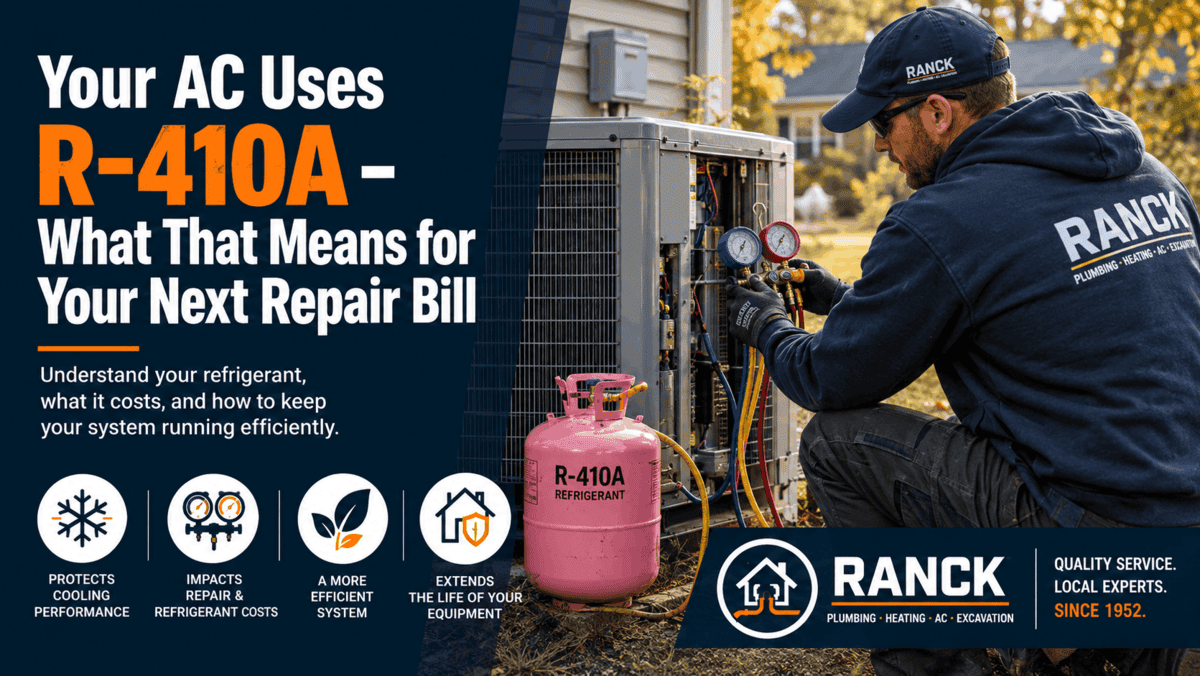
Your AC Uses R-410A - What That Means for Your Next Repair Bill
If your air conditioner or heat pump was installed before 2025, it almost certainly runs on R-410A. You may have heard that R-410A is being “banned,” or that your system is about to become illegal, or that you need to replace it now before something changes. None of that is true. What is true is narrower and more practical: R-410A is getting more expensive every year, and that changes the math on one specific kind of repair. Here is what Lancaster County homeowners actually need to know.
The Short Version
- Your existing R-410A system is legal. You can keep running it, repairing it, and recharging it. There is no rule requiring you to replace a working system.
- New equipment is different. Manufacturers stopped producing R-410A residential systems on January 1, 2025. New systems sold today use R-454B or R-32 instead.
- Refrigerant is getting pricier. As production allowances shrink under federal law, R-410A costs more each year. That makes leak repairs on older systems progressively more expensive.
- The decision this actually affects is whether to repair or replace when an aging system develops a significant refrigerant leak.
What Changed, and What Did Not
The American Innovation and Manufacturing Act, passed in 2020, directs the EPA to phase down the production of hydrofluorocarbon refrigerants by 85% by 2036. R-410A is one of those refrigerants, with a global warming potential of roughly 2,088. Its replacements, R-454B and R-32, come in well under the 700 limit the EPA set for new residential equipment.
The rule that took effect on January 1, 2025 was a manufacturing restriction. Factories stopped building new residential air conditioners and heat pumps charged with R-410A. It said nothing about the system sitting beside your house.
There was originally a second deadline, January 1, 2026, that would have stopped contractors from installing R-410A equipment still sitting in warehouses. That one caused significant confusion, and the EPA reversed it. A final rule published in May 2026, effective July 27, 2026, removed that installation deadline entirely. Equipment manufactured or imported before January 1, 2025 can be installed until existing supplies run out.
What none of this touched: servicing your current system. The EPA is explicit that you can continue to repair existing air conditioning and heat pump equipment, and that repair includes replacing major components. Reclaimed and stockpiled R-410A remains available for servicing legacy systems.
Why R-410A Refrigerant Costs More Every Year
Here is the part that affects your wallet. R-410A production is shrinking on a fixed federal schedule, while the installed base of R-410A systems in Lancaster County homes is shrinking much more slowly. A well-maintained system lasts fifteen to twenty years, which means millions of systems will still need refrigerant long after production has been cut back.
Supply falls, demand stays high, price climbs. Wholesale R-410A has risen sharply since 2023, and commonly quoted installed prices in 2026 run in the range of $80 to $150 per pound depending on market and supply. A typical residential recharge of two to four pounds lands somewhere in the low hundreds, where the same service cost noticeably less a few years ago.
This is not a contractor marking up your invoice for sport. It is a legislated supply curve working exactly as designed. A reputable company should be able to show you what they paid and explain the charge.
Low Refrigerant Always Means a Leak
This is the most important thing in this article, and it gets skipped constantly.
Refrigerant is not fuel. It is not consumed the way gasoline or heating oil is. It circulates in a sealed loop and, in a healthy system, the charge you started with is the charge you have twenty years later. If your system is low on refrigerant, it is leaking. There is no other explanation.
That matters more now than it used to. When refrigerant was cheap, “topping off” a slow leak each season was an annoying but survivable habit. At current prices, paying to refill a leaking system year after year means paying repeatedly for refrigerant that ends up in the atmosphere, with the underlying problem untouched and usually getting worse.
The right sequence is to find the leak first. A technician should perform a proper leak search, whether with electronic detection, UV dye, or a nitrogen pressure test, identify the failure point, quote the repair, and then recharge to the manufacturer’s specified weight. If someone wants to add refrigerant without looking for the leak, get a second opinion.
You Cannot Put R-454B in an R-410A System
Homeowners ask this constantly, and the answer is a firm no. R-454B is not a drop-in replacement. It runs at different pressures, requires different components and safety features, and is classified as an A2L, or mildly flammable, refrigerant. Substituting it into equipment that was not designed for it is unsafe and not permitted.
There is no conversion kit and no retrofit path for a residential R-410A system. Moving to R-454B means new equipment, which is precisely why the repair-versus-replace question is the one worth thinking about carefully.
While we are here: A2L refrigerants are safe when installed to code. New systems include leak detection, specific labeling, and design features built around that classification. Modern equipment using R-454B or R-32 is not a risk to your family, and any contractor implying otherwise is selling something.
When Repair Still Wins, and When It Does Not
The refrigerant transition is real, but it is not a reason to replace a healthy system. Here is how the decision usually breaks down.
Repair generally makes sense when:
- The system is under roughly ten years old and has been maintained
- The leak is accessible and repairable, such as a service valve, a fitting, or a line set connection
- The total repair, including refrigerant, is a modest fraction of replacement cost
- The rest of the system, particularly the compressor, is in good condition
Replacement generally makes sense when:
- The system is twelve to fifteen years or older and facing a major repair
- The leak is in the evaporator coil or condenser coil, where the repair often approaches the cost of significant new equipment
- The compressor has failed, which on an older system is usually the end of the line
- You are facing repeated repairs across consecutive seasons
- Your system runs on R-22, which applies to units installed roughly before 2010. R-22 production ended in 2020, and a recharge today can cost more than the equipment is worth. For a leaking R-22 system, replacement is nearly always the answer.
A useful sanity check: a large repair bill on a system with three or four years of life left buys you three or four years. The same money toward replacement buys you fifteen, at higher efficiency, with a warranty, and current HVAC rebates for Lancaster County homeowners can shift the math further. Run the number, do not run on instinct.
If You Are Buying New in 2026, Ask What Is in the Box
Because the EPA removed the installation deadline, some remaining pre-2025 R-410A inventory is still being sold and installed. That is legal, and in some cases it is genuinely a good deal. It is also something you should know about before you sign.
Questions worth asking:
- Is this system charged with R-410A, R-454B, or R-32?
- If it is R-410A, is the price meaningfully lower to reflect that?
- What does the warranty cover, and for how long?
- What will refrigerant cost to service this system in ten years?
There is a reasonable case for either choice. Pre-2025 R-410A equipment can carry a lower up-front price and uses a refrigerant every technician has worked with for two decades. New R-454B equipment aligns with where parts, supply, and service are heading for the rest of the system’s life. What matters is that you are making the choice deliberately rather than discovering it on the invoice.
What This Means for a Lancaster County Summer
Systems in this area work hard. Humid July stretches mean long runtimes, and long runtimes find weak points, particularly in coils and connections on equipment that has been in service more than a decade.
The single best protection against a surprise refrigerant bill is catching a small leak while it is still small. An annual cooling tune-up checks system pressures and superheat and subcooling readings against spec, which is how a technician notices a charge that has drifted low before you notice warm air on the hottest day of the year. It is also how you avoid discovering the problem during the week when every contractor in the county is booked.
Get a Straight Answer About Your R-410A System
If your AC is running but not cooling well, or someone has told you it needs refrigerant, the useful next step is a diagnosis that tells you where the charge is going and what it costs to fix, not a sales pitch built on a refrigerant rule that does not apply to your house.
Ranck has served Lancaster County since 1953, and nearly 90% of our work comes from returning customers and referrals. That only happens if you tell people the truth about whether their system needs replacing. We handle cooling repairs, system replacement, and maintenance plans across Lancaster County and surrounding areas, with 24/7 availability when a system fails at the worst possible time.
Call Ranck at 717-397-2577 for a straight diagnosis of what your system needs, and what it will actually cost.